I didn't start out trying to build software. I started out trying to survive as a trader.
Three decades ago I sat down in front of a screen with real money and no safety net, trying to work out what actually moved price. Everyone around me was studying candles, patterns, indicators — the visible surface of the market. It took me years to realise I was asking the wrong question. Price isn't the thing that matters. Price is the last thing that happens, after thousands of traders have already changed their minds about what comes next.
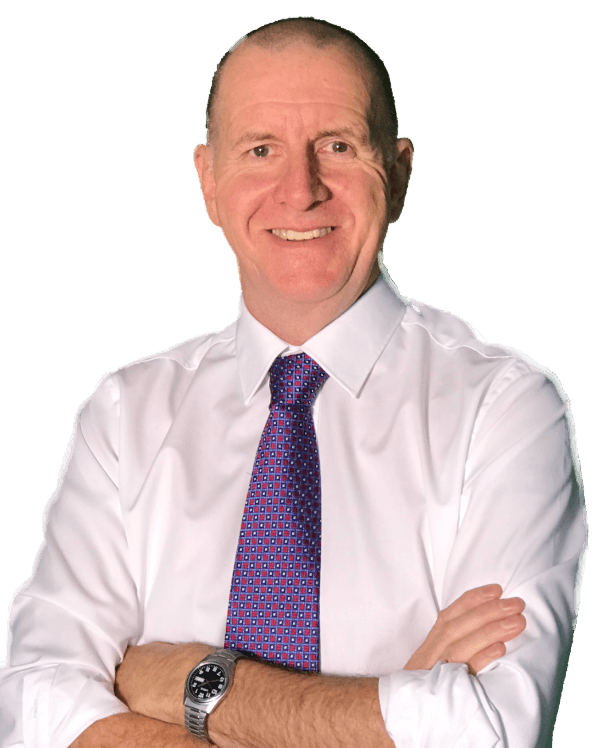
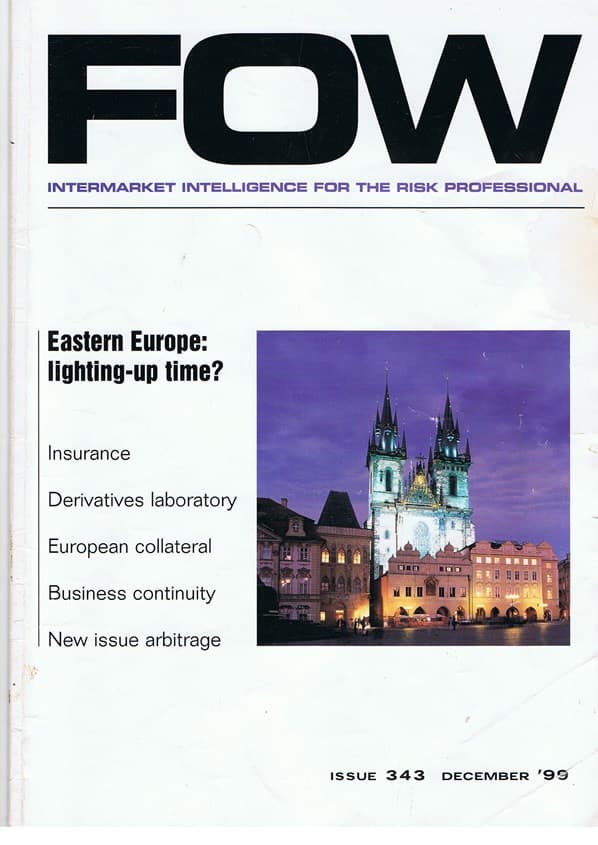
In December 1999, Futures and Options World ran a feature on me titled "Beyond Belief." At the time it was about a trending-day call rate better than 8 out of 10. Looking back now, the title feels like it was waiting for me to catch up to it — because everything I've built since has been about exactly that: what traders believe, and how that belief moves through a market before price ever confirms it.
In 1999, I named what I was seeing the Market Maker Method — Accumulation, Manipulation, Distribution.
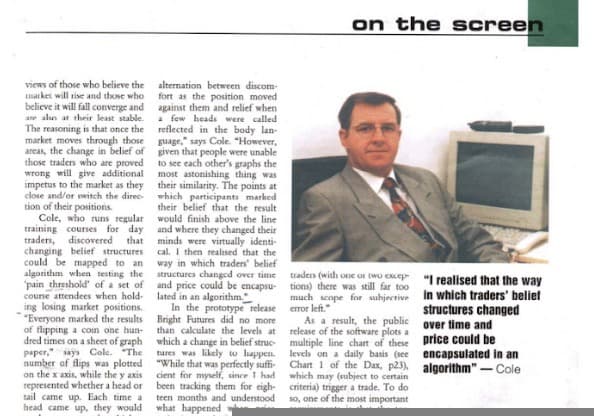
"I realised that the way in which traders' belief structures changed over time and price could be encapsulated in an algorithm."
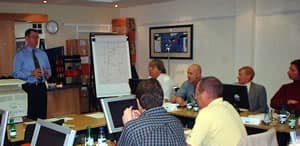
Five years into trading my own account, it had done well enough that I could stop needing a job. I moved to Spain, where I lived for ten years, and kept trading. I didn't become a trading educator overnight. For about three of those years I also ran small, bespoke courses — around four a year, with six to ten traders on each — and I taught in a way almost nobody else in this industry is willing to: live, with real money, in front of a room. No simulated accounts. No "here's what would have happened." Real positions, real risk, real screens, on the day, with people watching. If what I was teaching didn't work, everyone in that room would have known it immediately — including me. While I was in Spain I wrote "How the Market Makers Extract Millions of Dollars a Day" — the same framework taught on paper. It's since picked up more than 560 reviews on Amazon, averaging 4.3 stars. I later wrote "Why Traders Misunderstand the Market", which continues that examination of market behaviour, liquidity and market psychology.
That's where the real education happened, on both sides of the room. Watching serious traders try to apply what I knew taught me more about why people get stuck than any amount of solo screen time ever could. It's rarely a lack of effort or discipline. It's that almost every tool built for retail traders is built around price, when price was never the real signal.
PAT — the Professional Activity Tracker — is the tool I wished existed the entire time I was trading and teaching. PAT for TradingView is one indicator on an ordinary candle chart. It is there to help a trader interpret what is developing, through the Market Maker Method: Accumulation, Manipulation and Distribution, which I also teach as Profit Release. A Ray Line, a purple dot or a Pressure Point belongs to that reading. None of them predicts the next price.
I get asked that a lot, and it's usually asked about people who deserve to be asked it. So here's my honest answer. I did trade it myself, for decades. Twelve, fourteen hours a day at screens, for years on end. It worked — but it also cost me. Real health problems, in my legs, from that many hours sitting in front of a monitor day after day. I see other traders heading down the same road right now, and I recognise exactly where it leads.
I'm 67. I've already done the version of this where you sacrifice your body for the account balance. What I love now is watching someone else finally see what I spent decades learning to see, and knowing they'll get there without paying the same physical price I did.
These days I'm, for the most part, retired, and I no longer actively trade. I spend my time helping traders instead — including PAT subscribers, who can send me a short video of their chart and their questions and get my comments back on it. The lesson I most want to pass on is the one my health taught me: the answer isn't more hours at the screen, it's knowing which moments are worth being there for.
PAT Partner Programme
Join me in helping traders see what they’ve been missing.
Introduce PAT to your audience and earn US$20 recurring commission on qualifying monthly payments.